

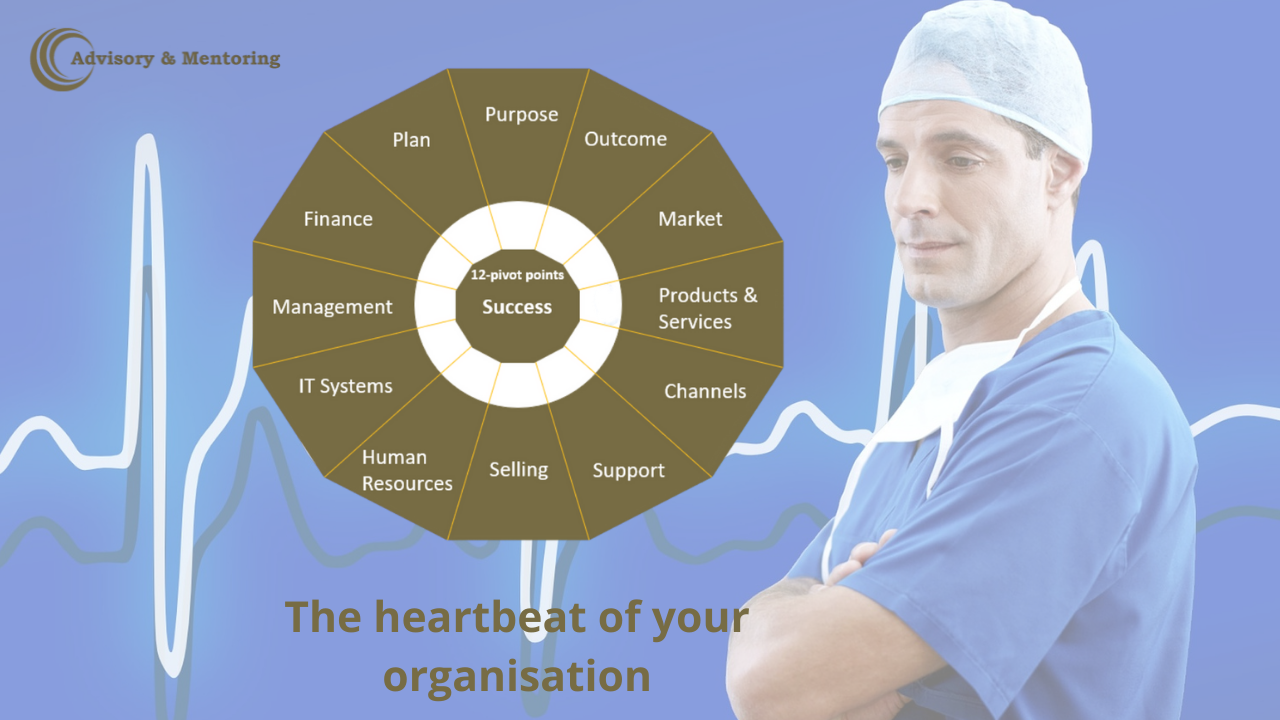
Let's discover the Pivot-Point number 3: the market
Owners (or the proxied corporation) choose the broad environment (market) in which to participate in order to extract the benefit sought by owners.
This doesn’t imply that these choices are always correct. Sometimes decisions to embark into new m...

Project governance refers to the management framework in which the project will be “held accountable” to the authority of the organization.
Some people say that governance is the way decisions are made. In reality, it’s more about the way in-project decisions are reviewed and authorized to ensure:
...
What has 40-years of helping corporations and organisations taught us?
We have learned that there are 12 Pivot-Points in every organisation that must be conquered to satisfy that organisation’s objectives. Failure in any of these Pivot-Points will compromise objectives and may even cause failure.
Thi...
Picture this: you’re sitting in a business meeting watching proceedings. The senior multi-cultural manager attendees are meeting to resolve a major issue.
The leader, who has been in the industry and CEO of the organisation for a couple of decades, is chairing the meeting.
There is general agreeme...

People often assume that leaders automatically come up with the right answers because of the position they hold. The thought is that “they wouldn’t be leaders if they didn’t come up with the right solutions most of the time.”
One would like to think so, but the reality is different.
The leader of a...

Extract from the book by Cenred Harmsworth and Dr Jack Jacoby, Managing Change Initiatives
Available in Hard Back, Soft Back and eBook from Amazon
DEFINITION AND OVERVIEW
Preparing for change is the assessment, consideration, and preparation an organization makes before the change process actually ...

The Environment of Change
The management of change environment covers a number of key dimensions. Each of these dimensions has the ability to enable more effective transformation (change) or, in its absence, seriously compromise a change initiative.
These environments (or “influencers”) are critic...

With so much change occurring across the entire economy and society, communications have become the critical link between the organisation and every one of its stakeholders; between achieving your objectives, and not; between increasing your risk, and managing your risk; between being perceived as a...

It has been frequently demonstrated that a transformation, program, project, or process improvement activity will stand a far greater chance of success if people know what is going on.
Specifically, that people involved in, or impacted by the change, should know the following regarding the change p...

A change initiative generally evolves through a number of phases.
PHASE 1: THE NEED
Someone (inside or outside of the organization) identifies that things are not as they should be or could be and that something needs to be done to better align the issue, function, process, or outcomes.
PHASE ...

Proactive, collaborative and transparent leaders consider, the effect and reaction from others when looking at what changes in action, behaviour or management style will have over the team or department in their organisations. These leaders carefully measure how a decision relating to one department...

This blog post is a chapter extract from the book by Cenred Harmsworth and Dr Jack Jacoby: Managing Change Initiatives
Available in Hard Back, Soft Back and eBook from Amazon.
Definition and Overview
A business case presents and assesses the business justification for initiating a task or project.
...Receive our executive monthly blog posts in your inbox
Blog Registration
You can unsubscribe at any time.
